A closer look at the numbers, coaching criticism and the narratives surrounding one of the sport’s emerging contenders.
Six games into the season, USC is 5–1, averaging nearly 98 points and more than 22 assists per game. Yet some of the conversation surrounding the Trojans is already about whether their best players can coexist.
After one of my recent postgame recap shows, a viewer left a comment to me asking about another YouTube channel suggesting that Jazzy Davidson was tired of playing with JuJu Watkins. This was a secondhand claim, not something Davidson had said.
Five games. That's all it took for two players who share a close friendship to be positioned as adversaries.
I also came across a post on X suggesting that UCLA could pick up USC players through the transfer portal if Watkins didn't involve her teammates enough. The post offered no evidence that anyone was considering leaving.
South Carolina and UCLA have talented recruiting classes coming in next season. In the conversations I've followed, I haven't seen nearly the same level of speculation about how those players will coexist. Why is having multiple stars considered a luxury elsewhere but a potential problem at USC?
Comparable performances, different narratives
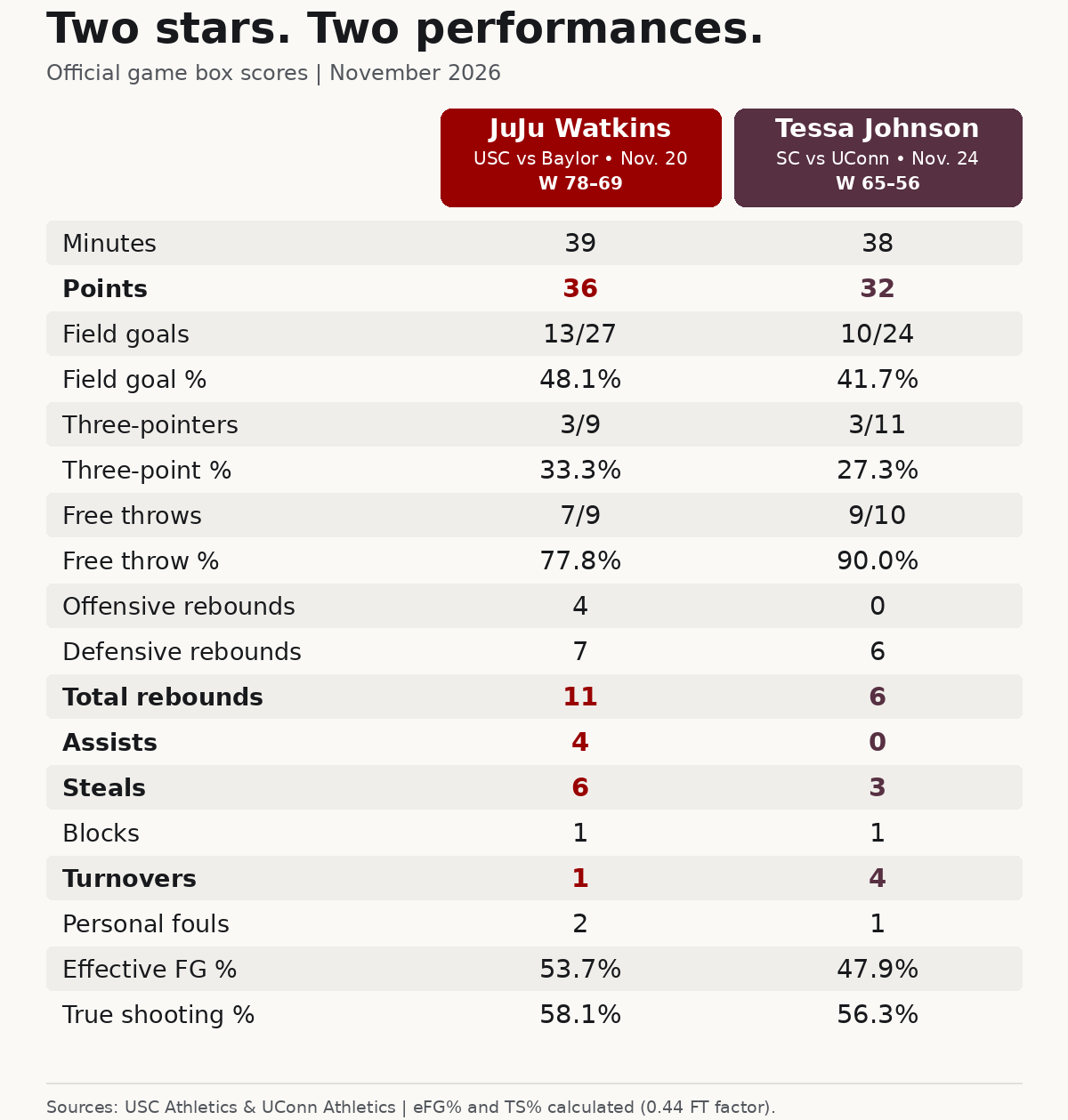
Tessa Johnson was rightfully celebrated after South Carolina's 65–56 win over UConn on November 24. I saw people on X praising her as the best player on the floor. Johnson scored a career-high 32 points on 10-of-24 shooting (41.7%), with six rebounds, zero assists, three steals, one block and four turnovers.
Four days earlier, Watkins led USC to a 78–69 win over Baylor with 36 points on 13-of-27 shooting (48.1%). She also had 11 rebounds, four assists, six steals, one block and just one turnover. Four of those rebounds were offensive.
Watkins had the stronger all-around stat line. Yet I continue to see comments calling JuJu a ball hog, saying she plays too much ISO, needs to get off the ball and doesn't involve her teammates enough.
Johnson had zero assists against UConn. While some people questioned her role as a playmaker, I haven't seen nearly the same chatter about her willingness to involve teammates or whether they can coexist with her. Instead, much of the reaction I saw focused on her scoring.
Now look at the numbers side by side
Johnson took 24 of South Carolina's 63 field-goal attempts (38.1%). Watkins took 27 of USC's 71 (38.0%). Johnson accounted for 49.2% of her team's points, compared with 46.2% for Watkins. Both teams won by nine points.
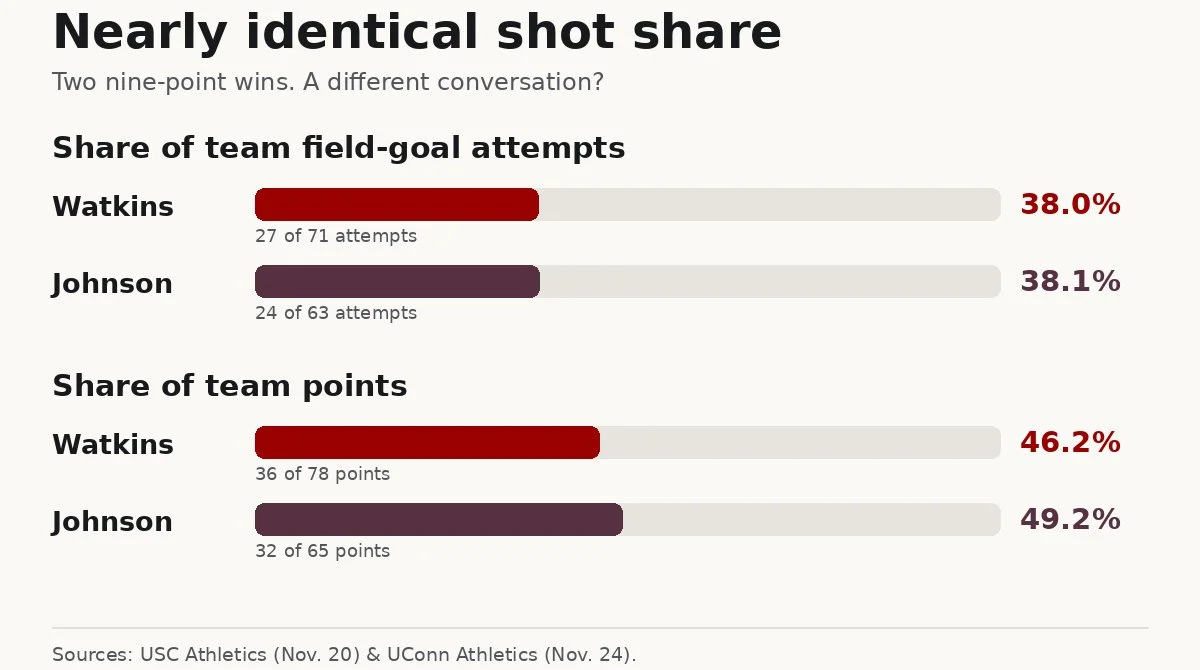
With virtually identical shares of their teams' shots, Watkins had five more rebounds, four more assists, twice as many steals, three fewer turnovers and better shooting efficiency from the field.
They faced different opponents and have different offensive responsibilities. Shot attempts don't tell us how long a player holds the ball, and assists don't account for every good pass. Johnson also stepped up with South Carolina's leading scorer, Joyce Edwards, unavailable.
Johnson deserves her flowers. Zero assists doesn't make her selfish, just as 27 shots doesn’t make Watkins a ball hog. My question is why comparable scoring performances can lead to such different conversations about team chemistry.
What the Numbers Say About USC's Offense
If the concern is whether USC shares the basketball, let's look at what the team is actually doing.
Through five games, four Trojans were averaging double figures: Watkins (26.8), Saniyah Hall (19.0), Davidson (15.4) and Kennedy Smith (10.2). Here are USC's five leading scorers through six games.
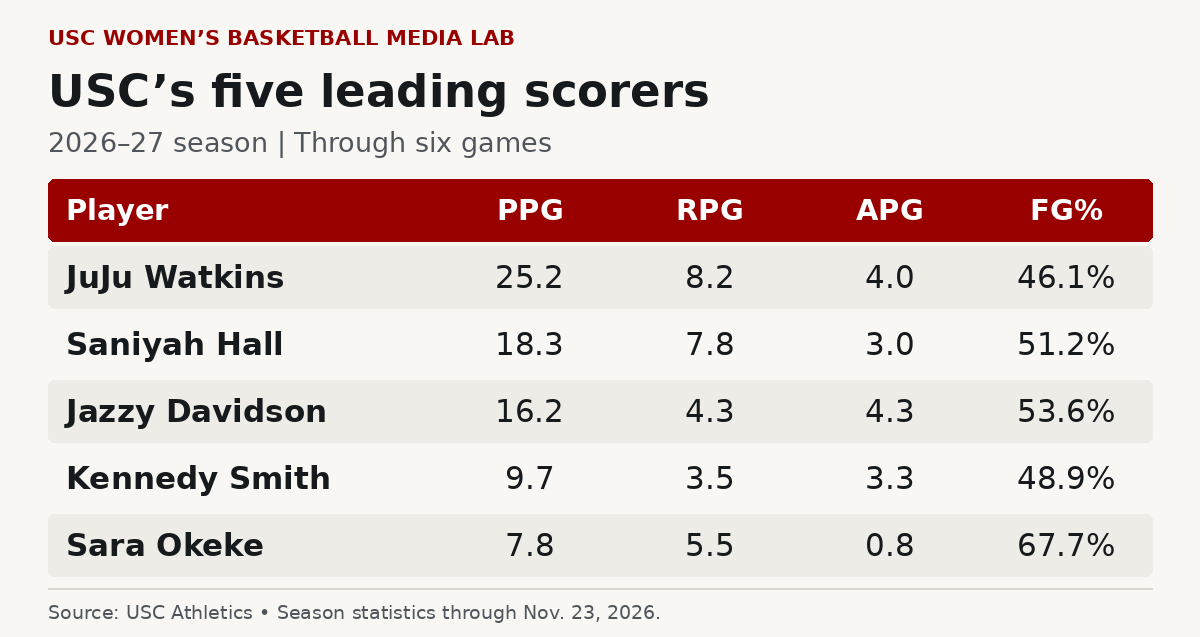
Davidson leads USC with 26 assists, followed by Watkins (24), Ryann Bennett (23), Smith (20) and Hall (18). The Big Ten's November 24 release also placed Bennett third nationally in assist-to-turnover ratio (7.67).
Against Northern Arizona on November 23, five Trojans scored in double figures: Davidson (20), Watkins (17), Sara Okeke (17), Hall (15) and Pania Davis (12). USC recorded 34 assists on 43 made field goals. That's an assist on approximately 79% of its baskets. According to USC Athletics, the 34 assists matched the program's highest total since 1982.
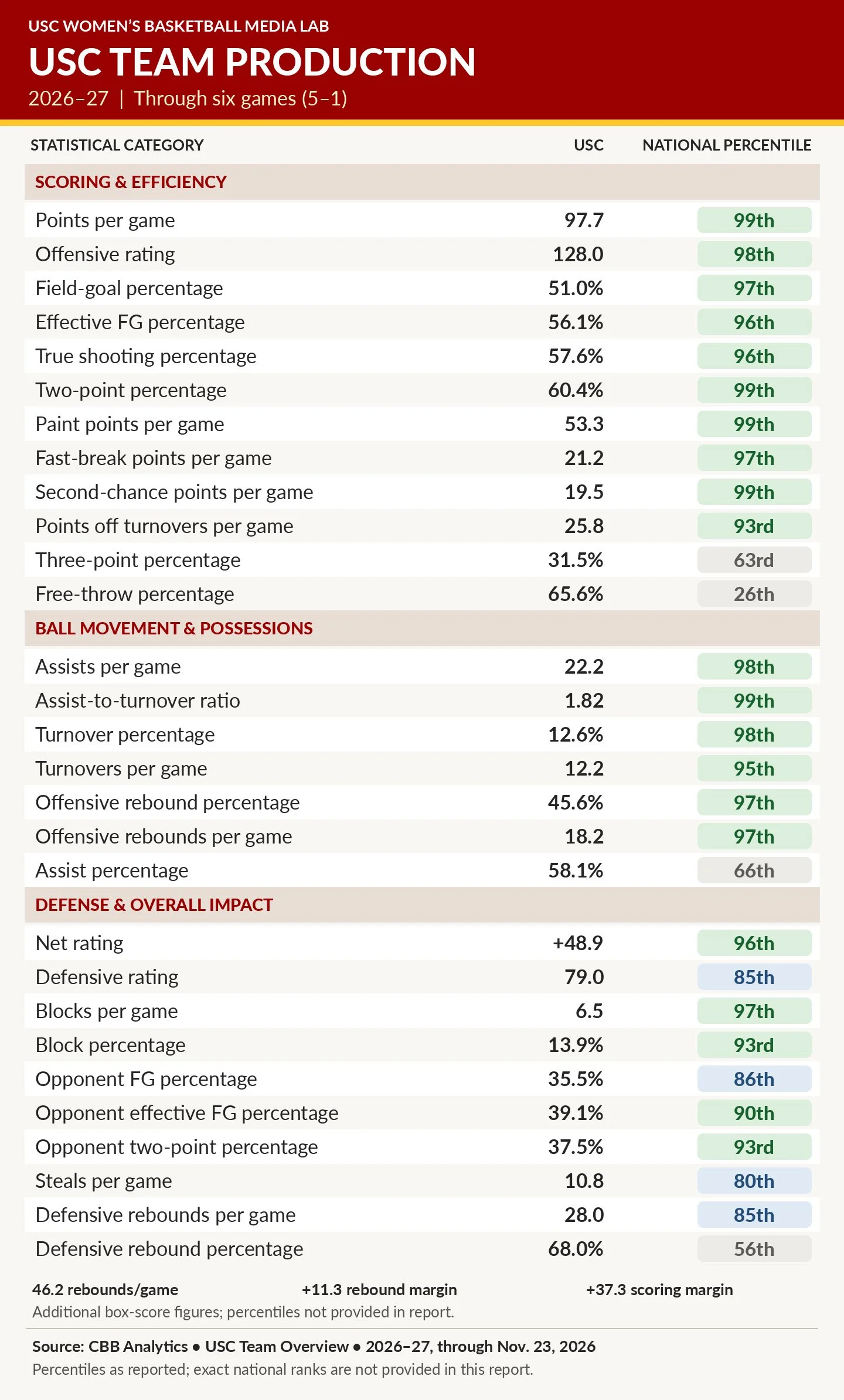
Of all the numbers in the CBB Analytics report, three stand out to me when it comes to the criticism of Lindsay Gottlieb's offense and USC's ball movement:
98th percentile nationally in assists per game.
98th percentile nationally in offensive efficiency.
99th percentile nationally in assist-to-turnover ratio.
USC is averaging 22.2 assists per game, scoring 128 points per 100 possessions and recording 1.82 assists for every turnover. In other words, the Trojans are creating scoring opportunities for one another, scoring efficiently and taking care of the basketball.
When people say Lindsay doesn't know how to run an offense, USC plays nothing but ISO basketball or JuJu doesn't involve her teammates, these are the numbers I think we need to consider. They don't mean every offensive possession is well executed, but they certainly challenge the idea that this team isn't sharing the basketball or playing effective offense.
USC is also in the 99th percentile nationally in scoring, the 97th percentile in field-goal percentage and the 98th percentile in turnover percentage. Its only loss through six games was by four points to South Carolina.
There are areas that need work. USC is in the 63rd percentile in three-point shooting, the 26th percentile in free-throw shooting and the 66th percentile in assist percentage. But six games into the season, the overall offensive numbers tell a very different story from the narrative that this team cannot play together.
Does USC have things to work on? Absolutely. I've discussed turnovers, rotations and half-court execution on my own shows. Six games is a small sample, and the competition matters. These numbers don't tell us what's happening inside the locker room, but they do show that several players are scoring and creating opportunities for others.
This team is still learning to play together.
Applying the Same Standard Against Quality Competition
Now, some may argue that USC's overall numbers are inflated by the level of competition it has faced. That's a fair argument, so let's look at the games against South Carolina and Baylor and apply that same standard to South Carolina's performances against Maryland, USC and UConn.
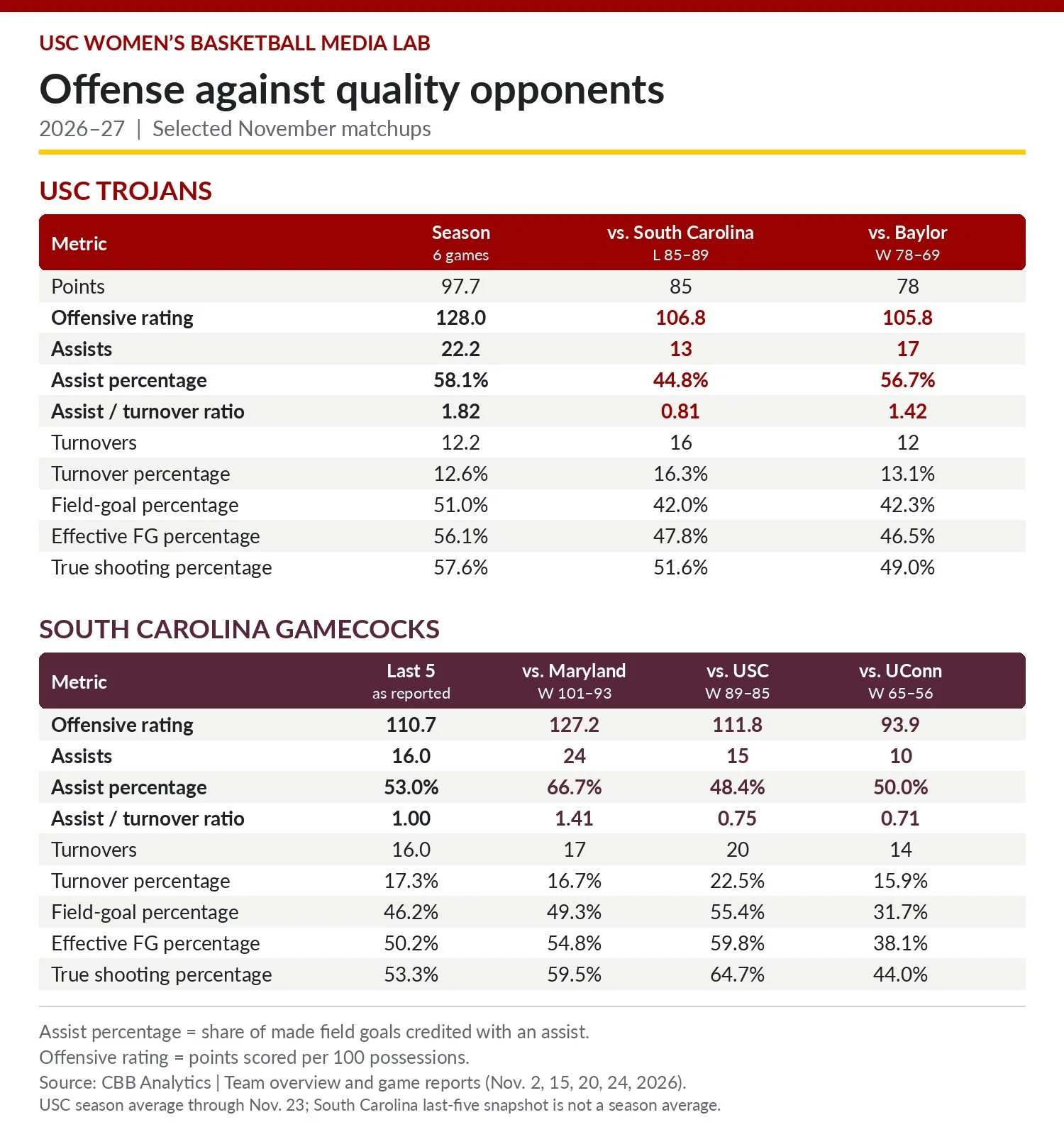
USC's offensive production declined in both games. Against South Carolina, the Trojans recorded 13 assists, and against Baylor, they recorded 17. One could say that was due to South Carolina’s defense, but regardless, it did decline.
However, against Baylor, USC's assist percentage was 56.7%, compared to its season average of 58.1%. Despite shooting considerably below its season average, USC was still recording assists on nearly the same percentage of its made baskets.
Against South Carolina, the decline in assist percentage and ball security was more noticeable. Those are legitimate areas of concern and should be part of any honest evaluation of USC's offense.
Now let's apply that same standard to South Carolina.
The Gamecocks recorded 24 assists against Maryland, 15 against USC and just 10 against UConn. Against UConn, South Carolina shot 31.7% from the field, posted an offensive rating of 93.9 and finished with 14 turnovers and 10 assists.
Yet much of the conversation I encountered following that game centered around Tessa Johnson's outstanding performance and the absence of Joyce Edwards. Both were legitimate talking points. Edwards' absence certainly could have contributed to South Carolina's offensive struggles.
What I didn't see was nearly the same level of criticism questioning South Carolina's offensive system, the team's cohesiveness or Dawn Staley's ability to coach that I routinely encounter when discussing USC.
When USC's offensive production declines against tougher competition, some of the criticism goes beyond basketball execution. Suddenly, Lindsay doesn't know how to run an offense, JuJu is a ball hog and the players supposedly cannot coexist. But you don’t see that with any of the “other teams”
The quality of the opponent, defensive schemes, personnel, pace and shot execution all impact offensive production. That's basketball, and it applies to every program.
Anyone who follows my coverage knows that I will be critical of USC when warranted. I did it continuously last year with regards to their frontcourt and 3 pt shooting. What I am asking for is consistency in how we evaluate teams, players and coaches across women's college basketball.
I've presented the individual statistics, the team statistics, the national percentiles and the game-specific numbers against quality opponents. The numbers are here for everyone to examine and draw their own conclusions.
So my question remains: Why do we continue to see this double standard when it comes to USC?
Imagine If Lindsay Gottlieb Said This
Following UConn's loss to South Carolina, reporter Daniel Connolly posted these remarks from Geno Auriemma on X:
“I'm having a real hard time coaching this team. You might be able to tell that. I'm having a really hard time coaching this team. I gotta figure that out, but it would be nice if I got a little help.”
This is another example of the double standard I see, but this time it extends beyond the players to the coaching staff. Imagine the headlines, YouTube videos and social media posts if Lindsay Gottlieb made that exact statement.
Based on the USC commentary I've followed, I suspect the conversation would quickly turn to whether Lindsay had lost the locker room, whether JuJu was difficult to coach or whether players were headed for the transfer portal.
To be fair, Geno received plenty of criticism. UConn had lost three games in November for the first time in program history, and some of the responses to Connolly's post were personal.
One commenter suggested Geno could only win with at least three five-star recruits. Another argued that he was successful when his roster was stacked with future WNBA stars but was struggling with fewer stars. Others questioned his coaching style and talent evaluation.
That's what caught my attention. Some people are arguing that Geno needs multiple superstars to succeed, while others suggest having multiple superstars is exactly what will prevent Lindsay from succeeding.
When UConn had Paige Bueckers, Azzi Fudd and Sarah Strong, that collection of talent helped the Huskies win a national championship. Why shouldn't Watkins, Davidson and Hall be given the opportunity to build something together at USC?
These aren't necessarily the same people making both arguments, and Geno's championship record speaks for itself. Both coaches should be held accountable for what happens on the court, but struggling to develop a team doesn't automatically mean a coach has lost the trust of their players.
When Basketball Criticism Becomes Personal
I saw another discussion on X after the South Carolina–UConn game, this time about Dawn Staley's offensive sets. The original post questioned why South Carolina was putting an off-ball finisher in a ballhandling role with little passing.
One response suggested Dawn was trying to give Johnson space to exploit a one-on-one matchup. Another questioned using Johnson as a primary playmaker when much of her scoring comes in transition or off the ball. The discussion went on to address player development, positionless basketball and who should handle the ball for South Carolina.
Another account came to Dawn's defense:
“Couch coach questioning Dawn coaching skills!!! SURE!!!”
That response dismissed the person raising the question rather than addressing the play itself.
What stood out to me was the willingness of some people to consider what Dawn might be trying to accomplish. I don't always see Lindsay afforded that same benefit of the doubt. In discussions about USC's offense, I've seen people go from criticizing a set to declaring that Lindsay doesn't know how to run an offense.
Dawn's championship résumé helps explain why fans may give her more latitude. That doesn't mean every play call is beyond question. The same factors matter when evaluating either coach: personnel, the opponent, execution and where the team is in its development.
Critique the spacing. Question the play call. Discuss the rotations. I do it myself.
But there's a difference between breaking down a possession and using it to speculate that players don't want to play together.
The Threat to the Established Hierarchy
I believe some of the hostility surrounding USC comes from its potential to disrupt the established hierarchy of women's college basketball.
UConn has enjoyed decades of dominance. South Carolina has reached the last two national championship games, falling short both times. UCLA won its first NCAA championship in April and continues to recruit at a high level. All three programs have given their fans plenty to celebrate.
Under Gottlieb, USC has landed the nation's No. 1 recruit in three of the last four recruiting classes: Watkins in 2023, Davidson in 2025 and Hall in 2026. Other elite programs wanted those players.
I believe recruiting envy, competitive insecurity and the fear of losing prominence may explain some of the reaction to USC's rise.
Rooting against a rival is part of sports. But when that turns into stories about fractured friendships and unhappy players without evidence, I start to question the endgame.
It reminds me of what we've seen in politics: repeat a narrative often enough, plant seeds of doubt and watch speculation begin to influence how people interpret events.
Perhaps some would rather see a potential rival unravel from within than watch it succeed. Others may simply know that controversy gets clicks.
I can't speak for entire fan bases, but I do believe these examples are worth examining.
Protecting the Sisterhood
In today's social media environment, it is so important that USC maintain a locker room built on mutual respect, trust, honest communication and sisterhood.
We've seen the damage that manufactured narratives and persistent division can cause.
My hope is that these young women continue to celebrate each other's success, address challenges directly with one another and never allow outside voices to define their relationships.
Because the greatest threat USC presents to the established hierarchy may not be its individual talent, but what that talent can accomplish when it remains united.