
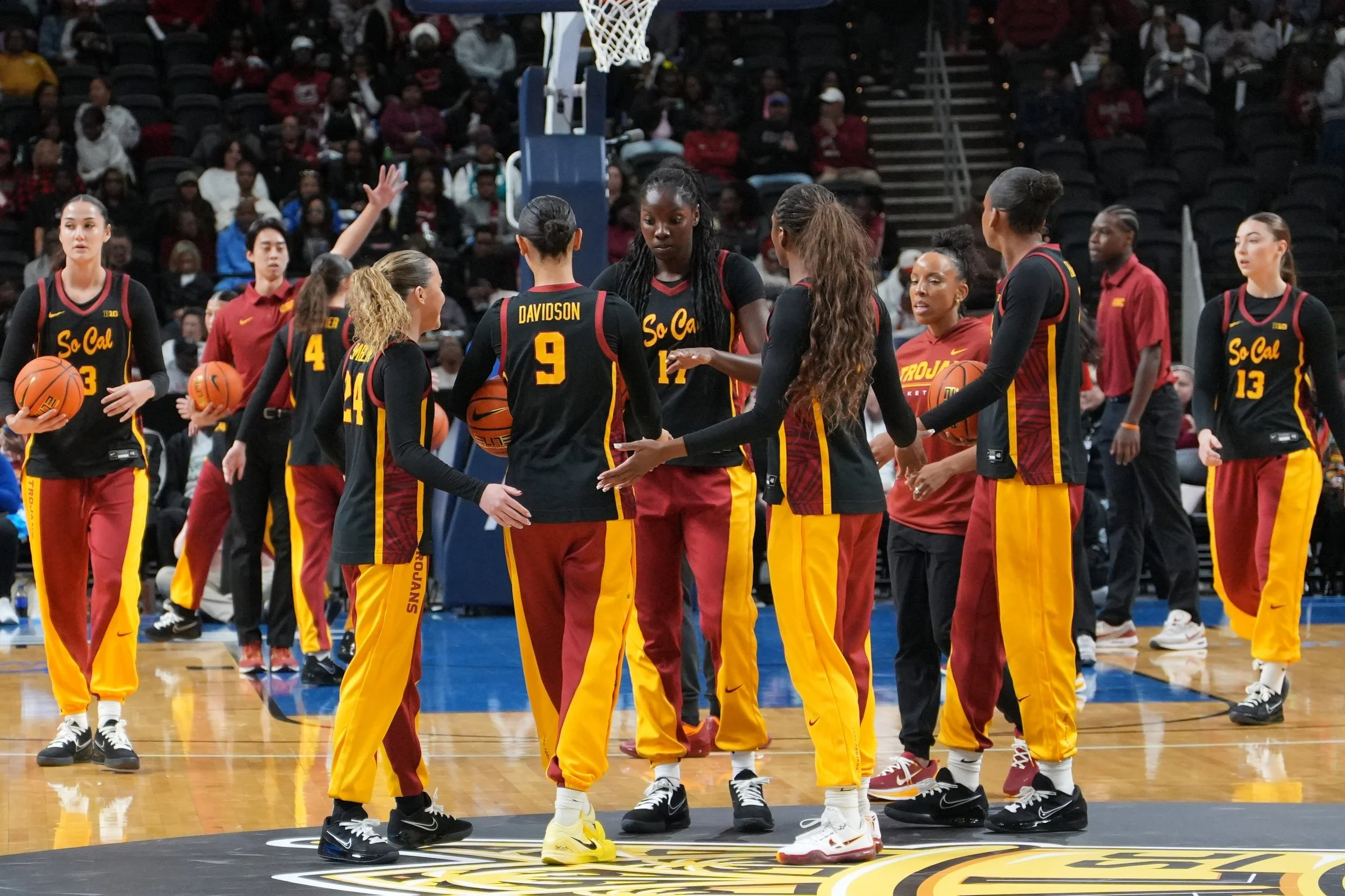
USC's lack of a traditional point guard, its collection of high-level scorers and Lindsay Gottlieb's offensive philosophy have become recurring subjects of debate. But the numbers, the structure of the offense and the direction of professional basketball challenge the argument that the Trojans need a conventional point guard to succeed.
The conversation surrounding USC women's basketball has become increasingly focused on what the Trojans supposedly lack rather than what they're actually doing on the basketball court. The criticism generally follows three arguments: USC needs a traditional point guard, its offense lacks structure, and having multiple high-level scorers creates problems with ball distribution and offensive rhythm.
But how much of that criticism is supported by the numbers? And are other programs being evaluated by the same standards?
Through five games of the 2026–27 season, USC holds a 4–1 record, averages 97.2 points per game and owns a 129.9 offensive rating, according to CBB Analytics. The Trojans are also averaging 19.8 assists against 11.2 turnovers per game. An offensive rating of 129.9 represents approximately 1.30 points per possession using CBB Analytics' calculation, or nearly 130 points for every 100 possessions.
Those figures don't support the notion that USC cannot operate effectively without a traditional point guard. Instead, they show a productive offense built around multiple playmakers, scoring versatility and shared decision-making.
Much of the debate also fails to distinguish between having a traditional point guard, running organized offensive sets and executing those sets successfully. Those are separate basketball concepts, and treating them as interchangeable has contributed to the confusion surrounding USC's offensive approach.
The Point Guard Question: Position or Responsibility?
For decades, the traditional point guard was responsible for bringing the ball up the floor, initiating the offense, directing teammates and creating scoring opportunities. That role has evolved. Today's game features combo guards, point forwards and versatile wings capable of initiating offense, making reads out of ball screens and creating opportunities from different areas of the floor.
USC's roster reflects that approach. JuJu Watkins, Jazzy Davidson, Kennedy Smith, Saniyah Hall and Ryann Bennett possess varying degrees of ball-handling and playmaking ability. Rather than relying on one player to facilitate every possession, USC distributes those responsibilities.
Through five games, Davidson leads the team with 22 assists, followed by Watkins with 18, Smith with 16, Bennett with 14 and Hall with 13. Those five players have combined for 83 of USC's 99 assists, approximately 84% of the team's total.
Davidson averages 4.4 assists per game, while Bennett's 6.1 assists per 40 minutes provide another source of playmaking off the bench. USC's assist-to-turnover ratio stands at 1.77, and its turnover percentage is just 11.9%, placing the Trojans in the 99th percentile nationally, according to CBB Analytics.
These statistics measure different aspects of ball handling. Assist-to-turnover ratio compares assists with turnovers, while turnover percentage measures the share of possessions ending in a turnover. Together, they show a team distributing playmaking responsibilities while protecting the basketball at an exceptionally high rate.
For a program frequently criticized for lacking a traditional point guard, that production deserves consideration. USC is sharing the responsibility for initiating offense while maintaining excellent possession efficiency. The debate shouldn't center on whether a player fits the conventional definition of a point guard, but whether the players handling those responsibilities are producing results.
South Carolina provides an interesting comparison, particularly because the Gamecocks defeated USC on November 15. Following Raven Johnson's departure and Maddy McDaniel's exit from the program, Dawn Staley entered the 2026–27 season without an established traditional starting point guard. Her solution was to distribute those responsibilities among several players, utilizing a point-guard-by-committee approach.
Tessa Johnson, Agot Makeer, Brooke Quarles-Daniels and other guards have shared responsibilities for initiating South Carolina's offense. Forwards such as Joyce Edwards have also been used to initiate offensive actions. In an October report by On3's Chris Wellbaum, Staley explained that she wanted her guards to advance the basketball, move it early and return to their natural offensive roles as scorers and shooters.
South Carolina's point guard situation has received media scrutiny, so it would be inaccurate to suggest that the Gamecocks have faced no questions about the position. The difference is how the same approach is sometimes evaluated. With South Carolina, the discussion has included how several guards can collectively handle point guard responsibilities. With USC, some critics have treated the absence of a traditional point guard as an offensive deficiency before examining the team's actual production.
Both programs are using talented guards who can score and facilitate, asking players to operate beyond the responsibilities historically assigned to their positions.
CBB Analytics provides a useful comparison from their November 15 matchup. South Carolina finished with a 111.8 offensive rating compared with USC's 106.8. The Gamecocks held a 42–30 advantage in paint scoring, while the teams produced nearly identical fast-break totals, with South Carolina scoring 16 and USC 15.
South Carolina won 89–85, but both programs generated more than one point per possession while distributing their ball-handling responsibilities. The result demonstrated that South Carolina was more efficient in that matchup. It didn't establish that one program requires a traditional point guard while the other can operate without one.
If distributing playmaking responsibilities is a legitimate coaching approach for South Carolina, it deserves the same consideration for USC. The standard should be consistent across college basketball.
Understanding Lindsay Gottlieb's Pro-Style Offense
Another criticism directed at USC is that the Trojans don't run an identifiable offense. That argument often overlooks the difference between running an offensive set and how a possession eventually ends.
USC incorporates ball screens, spacing principles, drive-and-kick opportunities, two-player actions and designed scoring opportunities for its perimeter players. A scouting report published by SicEm365 ahead of USC's game against Baylor highlighted an after-timeout set Lindsay Gottlieb designed to create an opportunity for Jazzy Davidson. The same report identified USC's preference for attacking favorable matchups with its talented guards.
Both can exist within the same offense. A team can run a designed action, create a defensive mismatch and allow a player to attack that advantage. The possession might end in isolation, but that doesn't mean the offense began without structure. Four-out, one-in spacing, for example, establishes an alignment that allows for several actions without requiring every possession to end with the same play or player.
Gottlieb's offensive philosophy draws heavily from professional basketball. She spent time as an assistant coach with the Cleveland Cavaliers, and her approach at USC incorporates NBA-style spacing, transition opportunities and player-driven decision-making. Rather than depending exclusively on predetermined plays, USC operates within a flexible structure that flows into different shapes and actions based on defensive coverage.
In a traditional scripted offense, a coach may call a play requiring players to move through a predetermined sequence of screens, cuts and passes. A flow offense provides a framework of spacing rules and available actions, allowing players to determine which option best attacks the defense. Those shapes can include four-out, one-in alignments, ball-screen formations, dribble handoffs, two-player actions and off-ball screening combinations.
In a March 2024 NCAA Tournament interview, Gottlieb discussed what she learned during her time in the NBA, particularly the value of spacing and creating early offensive opportunities without having to direct every possession from the sideline. She explained that USC could establish its spacing and initiate actions in transition without calling a specific set play every time down the floor.
Following a defensive rebound, for example, a USC guard can advance the basketball while teammates sprint into their designated positions. One player might fill the corner, another the wing, while a post player runs toward the basket or trails the play to set a screen. If a defender is late recovering, the ball handler can attack. If the defense collapses toward the paint, she can pass to an open teammate. If the initial opportunity disappears, USC can flow into a drag screen, dribble handoff or another two-player action.
The players have been taught where to position themselves, which options are available and how to respond to different defensive coverages. Gottlieb doesn't have to stop the possession and call a play for those actions to occur.
In November 2026, Gottlieb offered another explanation of her offensive philosophy in comments reported by The Sporting Tribune. "We put them in pro style shapes where they can just figure out what the right basketball play is," Gottlieb said.
During an October 2026 appearance on Flagrant and Funny with Cari Champion and Jemele Hill, Gottlieb provided a more specific example involving USC's perimeter players. She explained that JuJu Watkins and Saniyah Hall might initiate an action on one side of the floor. If the defense loads up to stop them, the basketball can move to Jazzy Davidson and Kennedy Smith on the opposite side.
The first action doesn't have to produce a shot. It can force the defense to shift, allowing USC to attack from another area of the floor. A possession might begin with Watkins attacking a ball screen, continue with a pass to Davidson and finish with an action involving Smith. Someone watching only the final sequence might interpret the possession as isolation basketball without recognizing the earlier actions that created the scoring opportunity.
USC also prefers to create opportunities in transition, another aspect of the offense that is frequently misunderstood. Transition basketball is often associated with a fast break ending in an uncontested layup or a quick three-point attempt, but it encompasses more than the initial fast break.
A possession doesn't automatically become settled half-court offense because the basketball crosses midcourt or because the first scoring opportunity disappears. The key consideration is whether the defense has recovered, established its assignments and become organized.
A team can enter the frontcourt, execute a drag screen, reverse the basketball, initiate a dribble handoff and attack a closeout while the defense is still recovering. Those actions can occur during transition or early offense.
Coaches generally distinguish between the primary break, secondary break, early offense and settled half-court offense, although statistical providers may use different definitions. The primary break looks for an immediate scoring opportunity before the defense gets back. The secondary break extends the attack when the first opportunity isn't available, while early offense allows a team to continue attacking through screens, handoffs and ball reversals before defenders settle into their assignments.
Once the defense has recovered and eliminated those early advantages, the offense must operate against an organized half-court defense. USC can run several actions before reaching that point. Classifying every possession that lasts beyond the initial fast break as half-court offense can produce an inaccurate picture of what the Trojans are attempting to accomplish.
I examined these distinctions in a recent episode of Let's Talk USC Women's Basketball. Using USC's game against UNLV, game film and CBB Analytics, I broke down primary and secondary transition, half-court execution and second-chance scoring. The film provides examples of how to recognize each phase of an offensive possession rather than judging it solely by where the basketball is on the court. The full breakdown is available here: Transition vs. Half-Court Offense: What Most Basketball Fans Don't Realize!.
What the Analytics Show About USC's Transition Offense
CBB Analytics provides additional evidence of USC's effectiveness when attacking early in the possession. Through five games, the Trojans generated 1.44 points per possession on 165 possessions lasting between zero and 10 seconds, placing them in the 99th percentile nationally in that comparison. Their efficiency was 1.17 points per possession across 148 possessions lasting 10 to 20 seconds and 1.14 across 57 possessions lasting 20 to 30 seconds. On possessions extending beyond 30 seconds, USC averaged 0.83 points, although that category included only 12 possessions, too small a sample to support a firm conclusion.
The numbers reflect USC's ability to generate efficient scoring opportunities early in the shot clock, consistent with Gottlieb's preference for attacking before the defense becomes organized.
Possession length and transition offense, however, are not identical measurements. A possession lasting eight seconds is not automatically a transition possession, just as a possession lasting 15 seconds is not necessarily settled half-court offense. The CBB Analytics breakdown measures scoring efficiency by elapsed time; it doesn't independently establish whether the defense was organized. The possession-length categories also contain a different number of possessions than the advanced team summary, so they should be evaluated within their respective statistical classifications.
USC's transition scoring provides additional context. Through five games, the Trojans averaged 20.8 fast-break points, accounting for 21.4% of their total scoring. USC scored 104 fast-break points while allowing just 27, a 77-point advantage over its opponents. The Trojans generated at least 15 fast-break points in every game, including 15 against South Carolina and 18 against Baylor.
Transition is a substantial part of USC's offensive identity, and several players are capable of initiating those opportunities.
Gottlieb's read-and-react approach also requires considerable basketball IQ. Players must recognize defensive coverages, understand spacing and make decisions in real time. If a defense switches a ball screen, the ball handler must recognize the matchup and determine whether there's an advantage. If the defense traps, she needs to identify the available passing window. If a help defender collapses toward the basket, a teammate must recognize the opportunity to relocate, cut or create a passing angle.
Those decisions happen quickly and involve more than the player holding the basketball. All five players must understand their responsibilities within the offense and how a defensive reaction changes the available options. That requires communication, timing and familiarity with teammates. USC's players aren't simply being asked to execute a specific movement. They're being asked to recognize why that movement is necessary and when another option would be more effective.
One reason USC's offense draws criticism may be that it doesn't always resemble the more choreographed sets commonly associated with college basketball. There's something visually appealing about watching five players move in synchronization, execute screens, reverse the basketball and generate an open shot exactly as a play was designed.
Gottlieb's offense doesn't always produce that same visual result. At times, a possession can look disjointed as players respond to different defensive reads. That isn't unique to USC. Every college basketball program experiences possessions where players miss reads, timing is off or an opponent successfully disrupts an offensive action. The difference is that a player-driven system places more of those decisions directly in the hands of the players.
In a highly scripted set, players generally know where their teammates are supposed to move next. In a flow offense, the next action may depend on how several players interpret the same defensive coverage. A player may cut when the ball handler expects her to maintain spacing, or a teammate may slip a screen when another player anticipates contact.
When those reads aren't synchronized, the possession can look chaotic. A player-driven flow offense can be among the more mentally demanding systems to learn because it requires continuous decision-making rather than relying primarily on predetermined movement. That becomes especially challenging for younger players learning to operate alongside other high-level scorers. The process takes repetition, film study and game experience.
A possession that looks disorganized doesn't establish that an offense lacks structure. It may reflect players learning to execute the decisions the system requires.
There's also a difference between an offense looking polished and producing efficient basketball. A perfectly executed set can end with a contested shot, while an awkward-looking possession can produce a high-percentage opportunity because a player recognizes a mismatch. Shot quality, turnovers, spacing and offensive efficiency provide a more complete evaluation than appearance alone.
Gottlieb isn't simply teaching players to follow an offensive structure. She's asking them to develop the ability to organize possessions themselves.
Does USC Need a More Traditional College Offense?
Another argument is that USC would be better served running a more traditional college offense built around scripted sets, predetermined actions and a conventional point guard. It's a reasonable subject for basketball discussion, but the recommendation should be supported by evidence that a different structure would produce better results.
There's nothing inherently wrong with a traditional college offense. In her October 2026 interview with Cari Champion and Jemele Hill, Gottlieb acknowledged that teams using more scripted systems have won plenty of basketball games. She also recognized that a coach's offensive approach must account for the personnel available. Different systems can succeed with different rosters, and no single philosophy guarantees success.
That applies to every program across the NCAA. Whether a team runs a motion offense, continuity offense, five-out attack, traditional high-low system or professional-style flow offense, the coaching staff must make adjustments as opponents adapt. A missed read, a difficult shooting stretch or an ineffective possession is not unique to USC or any particular offensive philosophy.
Before concluding that USC needs to abandon its system, critics should identify where the current approach is failing and explain why a different one would produce better results.
USC's early analytics provide a useful starting point. The Trojans opened with a 130.2 offensive rating against UNLV, followed by 165.9 against Utah State and 143.9 against the College of Charleston. Against stronger competition, those numbers were 106.8 against South Carolina and 105.8 against Baylor.
Those figures should be examined within the context of the competition. South Carolina and Baylor present different defensive challenges than USC's earlier opponents. A decline in efficiency against stronger defensive personnel doesn't automatically indicate that a team's offensive philosophy is ineffective.
Against South Carolina, USC scored 85 points and shot 42.0% from the field. The Trojans finished with 30 points in the paint compared with South Carolina's 42. Against Baylor, USC scored 78 points, produced 44 points in the paint, collected 19 second-chance points and generated 18 fast-break points. The Trojans also overcame a 15-point deficit and outscored Baylor 63–43 over the final three quarters.
Those games illustrate different ways USC can generate offense against quality competition. Offensive production will change depending on an opponent's defensive approach, personnel and matchups. That's true throughout college basketball.
A team facing an elite defense should expect its preferred actions to be challenged. The same applies to South Carolina, UCLA, UConn, Texas and every other program competing at a high level. None operates against identical defensive conditions every night, and none executes every possession perfectly. The question is whether a team has the offensive versatility to respond.
USC's approach provides several options. The Trojans can score in transition, attack favorable matchups, run designed sets, use connected two-player actions and create opportunities through ball movement. Their players are being trained to recognize defensive adjustments rather than rely exclusively on one predetermined action.
The system also allows the coaching staff to incorporate counters when opponents take away an initial option. A flow offense can include after-timeout plays, designed screening actions and structured possessions without abandoning its underlying philosophy.
Gottlieb and her staff remain responsible for preparing players to execute those concepts, just as every NCAA coaching staff is responsible for teaching and adjusting its offense. But making adjustments shouldn't be treated as evidence that USC's system is defective. Adjustments are a routine part of coaching, regardless of the offensive structure.
A scripted offense can be effective. So can a flow offense. The distinction is how players are taught to create advantages and respond to defensive pressure.
A prettier offense isn't necessarily a better offense. The evaluation should come from the advantages it creates, the quality of the shots it produces and how efficiently the team converts those opportunities.
Through five games, USC's production demonstrates that Gottlieb's approach can generate efficient basketball without assigning every possession to a traditional point guard.
What USC's Shooting Numbers Reveal
CBB Analytics reports that USC is shooting 51.0% from the field, with a 56.6% effective field-goal percentage and 58.4% true shooting. The Trojans are converting 60.4% of their two-point attempts, while 87.8% of their made three-pointers have been assisted. Their overall assist percentage is 53.2%, meaning slightly more than half of USC's made field goals come directly from a teammate's pass.
That assist percentage ranks around the 43rd–44th percentile nationally, according to CBB Analytics. It reflects an offense that incorporates assisted scoring opportunities alongside individual shot creation, consistent with a system that allows talented perimeter players to attack favorable matchups.
The shot-location data shows where USC has been particularly effective. The Trojans have converted 94 of 130 attempts at the rim, shooting 72.3% and ranking in the 96th percentile nationally in that category. USC is also shooting 53.4% on other shots in the paint, converting 31 of 58 attempts, while making 20 of 52 midrange attempts for 38.5%.
The interior efficiency is substantial. Creating scoring opportunities around the basket is a primary objective of any offense, and USC has converted those opportunities at an exceptionally high rate.
The perimeter numbers provide another dimension. USC is shooting 28.0% on above-the-break three-pointers, converting 28 of 100 attempts. Those shots account for 80% of the team's three-point attempts. The Trojans are shooting 52.0% from the corners, making 13 of 25 attempts, although that percentage comes from a smaller sample.
Those figures identify where USC's perimeter shooting has been most effective through five games. They also provide an opportunity to examine shot selection and shot quality. A shooting percentage alone doesn't establish whether an offensive system is creating appropriate opportunities. That requires examining the defensive coverage, the quality of the attempt and the circumstances surrounding the shot.
Another statistic is particularly relevant to the criticism of USC's half-court offense. CBB Analytics reports that USC is shooting 42.7% from the field on attempts classified as half-court offense, placing the Trojans around the 89th percentile nationally in that category. Approximately 66% of USC's field-goal attempts have been classified as half-court attempts.
That is a notable figure for a team frequently described as incapable of executing against an organized defense.
The half-court shooting percentage is lower than USC's 51.0% overall field-goal percentage, but the two categories represent different offensive situations. Transition opportunities often produce more favorable scoring conditions than possessions against an organized defense.
The half-court figure also has limitations. Field-goal percentage doesn't include turnovers or free-throw scoring, and statistical providers may classify possessions differently. Nevertheless, ranking around the 89th percentile nationally in half-court field-goal percentage provides evidence that USC is generating productive shooting opportunities in that phase of the game.
Against South Carolina, 13 of USC's 29 made field goals were assisted. Against Baylor, the Trojans assisted on 17 of their 30 made field goals. Those totals reflect the combination of assisted scoring and individual creation within USC's offense.
An offense doesn't have to generate an assist on every made basket to be organized or efficient. The objective is to create a scoring advantage, whether it comes from ball movement, an offensive action or a player recognizing an opportunity to attack.
USC's overall efficiency, interior finishing, half-court shooting and turnover control provide substantial evidence that its offensive approach is producing results.
Multiple Stars and the Professional Game
The debate surrounding USC's multiple stars also deserves a closer look at the lineup data. According to CBB Analytics, the starting combination of Kennedy Smith, Saniyah Hall, JuJu Watkins, Jazzy Davidson and Sara Okeke has produced a 142.5 offensive rating across 113 possessions and 59 minutes.
During that stretch, the lineup recorded a 69.0 defensive rating and a +73.5 net rating, along with a 64.2% true-shooting percentage, 51.4% three-point shooting and a 13.2% turnover rate.
An offensive rating of 142.5 means that lineup has scored at a rate of approximately 142.5 points per 100 possessions, while the defensive rating of 69.0 means opponents have scored at a rate of approximately 69.0 points per 100 possessions against that group. The resulting +73.5 net rating represents a substantial scoring differential during its time on the floor.
Those figures are particularly relevant because this is the starting group featuring USC's most discussed perimeter stars. The claim that these players cannot function together deserves to be measured against the efficiency that lineup has produced.
The sample covers only five games, and lineup ratings will change as the season progresses. Different combinations also produce different results depending on personnel, matchups and the responsibilities assigned to individual players.
For example, the lineup of Smith, Hall, Watkins, Davidson and Laura Williams produced an 85.1 offensive rating across 22 possessions. That's a much smaller sample, but it illustrates how personnel combinations can influence production. Even the most talented professional teams use lineups that perform differently depending on spacing, screening, interior personnel and defensive matchups.
USC's assist-to-scorer connections offer another perspective. Through five games, Watkins has assisted six Davidson baskets and five Hall baskets. Davidson has assisted five Hall baskets and four Watkins baskets, while Smith has assisted four Davidson baskets and Hall has assisted four Smith baskets.
Those connections demonstrate that USC's perimeter players are contributing as both creators and finishers. The offense doesn't require one player to dominate every possession while the others wait for scoring opportunities. Having several players capable of creating their own shots and facilitating for teammates expands the ways a team can attack a defense.
The professional game provides several examples of teams operating with multiple offensive creators. Consider the Phoenix Mercury. In 2026, Alyssa Thomas, listed as a forward, led the WNBA with 8.5 assists per game, according to the league's official statistics. Thomas was one of Phoenix's primary facilitators, directing possessions and creating scoring opportunities despite not being a traditional point guard.
The Mercury also featured established scoring talent in Kahleah Copper and added Kelsey Plum during the season, although Plum's appearances with Phoenix were limited. Their offensive responsibilities weren't confined to one positional role.
The Las Vegas Aces provide another example. Their 2026 roster included A'ja Wilson, Chelsea Gray, Jackie Young and Jewell Loyd. Gray is an established traditional point guard, but she wasn't the only player entrusted with offensive decision-making. Young averaged 6.8 assists per game during the 2026 regular season, slightly more than Gray's 6.7, with both finishing among the league's top five in assists per game.
Las Vegas demonstrates that even teams with an established point guard can distribute playmaking responsibilities among several talented players. The offense can operate through different individuals depending on matchups, defensive coverages and personnel.
The New York Liberty also assembled multiple established stars capable of scoring, facilitating and contributing in different roles. Their 2026 roster featured Sabrina Ionescu, Breanna Stewart, Jonquel Jones and Satou Sabally, although injuries affected the availability of some players during the season.
Dallas entered 2026 with Paige Bueckers, Arike Ogunbowale and rookie Azzi Fudd, bringing together several talented perimeter scorers. Bueckers averaged 5.9 assists per game, while Ogunbowale averaged 3.3 and Fudd contributed 1.8, illustrating the different offensive responsibilities players can have within the same backcourt.
These teams aren't identical. Phoenix relies heavily on a point forward, Las Vegas features a traditional point guard alongside another elite facilitator, and New York and Dallas provide examples of organizations building around multiple offensive threats. But professional basketball doesn't operate under the assumption that only one player can initiate an offense or that multiple stars automatically create problems.
Professional teams value players who can score, facilitate, make decisions and adjust their roles depending on the personnel around them. If those combinations are accepted throughout professional basketball, why should a college program be criticized for developing players within a similar structure?
The professional game also provides examples of the offensive principles Gottlieb is incorporating at USC. During the Los Angeles Lakers' 2019–20 championship season, Frank Vogel implemented an offense built around LeBron James and Anthony Davis that emphasized transition, spacing, multiple offensive actions and defensive reads.
In a detailed explanation of the Lakers' offense published in Alqueria del Basket, Vogel discussed attacking in transition while allowing his stars to create opportunities within organized spacing. The Lakers incorporated drag screens, dribble handoffs, off-ball screens and other actions designed to generate advantages for James, Davis and their teammates.
Golden State provides another example. Under Steve Kerr, the Warriors have consistently incorporated motion principles, split actions, five-out spacing and player-driven reads. Stephen Curry, Draymond Green and their teammates frequently operate through connected actions rather than depending exclusively on a scripted play.
A possession might begin with a post entry, move into a split action, force the defense to shift and eventually produce an opportunity on the opposite side of the floor. Golden State's movement can appear spontaneous, but it is built on repetition, shared understanding and basketball intelligence.
Similar concepts are used throughout the WNBA. Under Becky Hammon, the Aces have emphasized pace, spacing and allowing players to recognize and attack advantages. The Liberty's 2023 offense under Sandy Brondello also incorporated actions that flowed from one side of the floor to the other.
Breanna Stewart, Sabrina Ionescu and Jonquel Jones operated in a system where the first action frequently created the opportunity for the next.
These teams have different personnel, coaching staffs and offensive priorities, but they share an emphasis on spacing, player recognition and connected actions. None should be treated as running Gottlieb's exact offense, but they illustrate how professional teams combine structure with player-driven decision-making.
Developing Players for the Next Level
The debate raises another question about player development. What skills should college coaches be preparing elite players to bring into the professional game?
A highly regarded college prospect won't necessarily enter the WNBA and immediately become the primary offensive option. Even a first-round draft pick may join a roster featuring multiple All-Stars, established scorers and veteran playmakers.
She'll have to contribute without dominating every possession. That means understanding how to play on and off the ball, recognize defensive rotations, maintain spacing and make decisions within a system featuring other talented players.
At the WNBA level, players face sophisticated defensive coverages, a faster shot clock and experienced defenders who recognize offensive tendencies quickly. Memorizing offensive plays is useful, but it isn't enough. Players must understand why an action creates an advantage, how the defense attempts to eliminate it and what adjustment should follow.
In her October 2026 interview with Cari Champion and Jemele Hill, Gottlieb connected USC's offensive philosophy directly to preparing players for professional basketball. She explained that her staff wants players to become comfortable with concepts and defensive coverages they'll encounter at the next level, even when professional teams use different terminology.
Gottlieb also discussed the importance of players arriving in the WNBA prepared to adjust to professional systems rather than having to abandon habits developed in college.
For Jazzy Davidson, learning to initiate offense, create for teammates and operate away from the ball provides experience that can translate to the professional game. The same applies to Watkins, Hall and USC's other perimeter players. They're being asked to develop as offensive decision-makers rather than remain confined to one role.
As with any college offensive system, developing those skills requires repetition, coaching and game experience. That's part of player development at every level of basketball.
Gottlieb addressed that issue during the October interview, explaining that players preparing for professional basketball benefit from learning how to play alongside other talented players rather than being the only offensive focal point.
Professional teams don't operate under the assumption that only one talented scorer can play at a time. College programs shouldn't be expected to develop players under that assumption either. A player who can create opportunities both with and without the basketball becomes more versatile, and versatility creates more opportunities at the next level.
USC's offensive philosophy places those responsibilities directly on its players, preparing them to make decisions in situations they'll eventually encounter against professional defenses.
Evaluate the Basketball, Not the Narrative
The conversation surrounding USC's offense should begin with what the numbers demonstrate. Through five games, USC has produced a 129.9 offensive rating, protected the basketball at an exceptionally high rate and shown that several players can facilitate. The Trojans have generated 1.44 points per possession during their quickest possessions, converted 72.3% of their attempts at the rim and received substantial production from their starting lineup.
CBB Analytics also places USC around the 89th percentile nationally in half-court field-goal percentage, providing another measure of the team's ability to generate offense beyond transition. Those aren't the statistical indicators one would expect from a team incapable of functioning without a traditional point guard.
Like every NCAA program, USC will encounter different defensive challenges throughout the season. Opponents will adjust, individual matchups will change and coaching staffs will incorporate new counters and actions. Those are routine demands of competitive basketball, regardless of the system being used.
The Trojans' shooting distribution and production against elite competition are appropriate subjects for further analysis, just as they would be for South Carolina, UCLA, UConn, Texas or any other nationally prominent program. But an offense shouldn't be judged deficient simply because its structure differs from what observers are accustomed to watching.
South Carolina is using a point-guard-by-committee approach, while professional basketball continues to provide examples of offenses built around multiple stars and versatile playmakers. The same standards should apply to everyone.
If the argument is that USC needs a traditional point guard, the statistical or film evidence should demonstrate how the absence of one is preventing the Trojans from generating efficient offense. If the argument is that USC's stars cannot coexist, the lineup data and on-court production should support that conclusion.
And if the argument is that USC doesn't run offensive sets, the evaluation should account for the actions the team initiates, the advantages those actions create and the way players respond to defensive coverage.
Simply repeating that USC needs a point guard, has too many stars or doesn't run an offense doesn't establish any of those claims.
Gottlieb's offensive philosophy is subject to the same execution demands and in-game adjustments every NCAA coaching staff faces. But the evidence doesn't support treating USC's use of multiple playmakers as an inherent offensive problem.
The Trojans are operating within a professional-style system emphasizing spacing, transition, connected actions and player-driven decisions. Their early production shows that those concepts can generate efficient basketball without relying exclusively on a traditional point guard.
The question isn't whether USC has a traditional point guard or too many stars. It's whether the players are producing efficient, sustainable offense within the system they're being asked to execute. Through five games, the numbers provide substantial evidence that they are.
And if college basketball is supposed to prepare players for professional careers, learning how to make decisions, share offensive responsibilities and play alongside other elite talents should be part of that preparation.
Criticism is part of sports. So is accountability. But if we're going to question USC's offensive philosophy, we should support those criticisms with the same numbers, film and basketball analysis we would use to evaluate any other program.
Sources and Reporting
Statistical research: CBB Analytics, 2026–27 USC women's basketball team, player, lineup, possession-length and shot-location statistics through November 20, 2026; USC Athletics cumulative statistics; Big Ten Conference statistics; WNBA official statistics.
Coaching and offensive philosophy: Lindsay Gottlieb's March 2024 NCAA Tournament press conference; Gottlieb's October 2026 interview on Flagrant and Funny; November 2026 reporting on USC's pro-style offensive shapes; South Carolina's point-guard-by-committee approach, On3; SicEm365's USC scouting report.
Professional offensive comparisons: Frank Vogel's 2019–20 Lakers offense; Golden State Warriors motion offense; New York Liberty offensive analysis; FIBA coaching manual.
Original film analysis: CeCe, Transition vs. Half-Court Offense: What Most Basketball Fans Don't Realize!, Let's Talk USC Women's Basketball.
Statistical note: CBB Analytics figures reflect the five-game sample ending November 20, 2026. Offensive ratings are expressed per 100 possessions. The equivalent 1.30 points per possession is derived from the 129.9 offensive rating. Possession-length statistics are reported separately and should not be treated as having the same denominator as the advanced team summary. Early-season percentile rankings and lineup ratings are subject to sample-size limitations.
© 2026 USC Women's Basketball Media Lab | Original Reporting & Analysis
