
Beyond the Box Score: The Real Freshman of the Year Debate
Every year, the National Freshman of the Year debate sounds simple. Who scored the most? Who had the biggest highlights? Who plays on the better team?
But basketball is never that simple.
This award forces a deeper question — one voters don’t always articulate out loud: What does impact actually mean?
Is it scoring efficiency? Offensive control? Defensive control? Team success? Two-way influence?
Right now, the national conversation has narrowed around two freshmen: Aubrey Galvan and Jazzy Davidson. Both are elite. Both deserve to be here. But the way they impact the game is fundamentally different. And that’s where this debate gets real.
Let’s start with Aubrey Galvan.
She’s a 5’6” freshman point guard in a Power Four conference who has developed into one of the most efficient offensive freshmen in the country. Over the full season, she’s averaging 12.8 points per game, roughly six assists per game, while posting a 52.3% True Shooting percentage on a 20.1% usage rate.
True Shooting percentage (TS%) measures scoring efficiency by combining two-point shots, three-point shots, and free throws into one metric. In simple terms: how efficiently does she turn possessions into points? At 52.3% overall — and 58.1% in Quad 1 games — Galvan is efficient within her role.
Her advanced metrics reinforce that profile. Galvan’s overall RAPM sits at 10.7. RAPM (Regularized Adjusted Plus-Minus) estimates how much better a team performs per 100 possessions when a player is on the floor, adjusting for teammates and opponents. It splits into two components: Offensive RAPM (6.9) and Defensive RAPM (3.8). That split matters. Her impact is weighted more heavily on the offensive side of the ball. When Galvan is on the floor, Vanderbilt’s offense improves significantly. The defensive influence is positive — but smaller in magnitude.
Then there’s WARP: 5.7. WARP (Wins Above Replacement Player) estimates how many additional wins a player contributes compared to a replacement-level rotational player. In practical terms, if Vanderbilt has 18 wins and Galvan’s WARP is 5.7, value models estimate that roughly five to six of those wins are tied to the additional value she provides beyond a standard rotation guard. It’s not subtraction math. It’s value modeling. And it’s meaningful.
Now we have to talk about ecosystem (the team structure, roles, and attention around a player). Efficiency doesn’t happen by itself. Galvan plays alongside Mikayla Blakes, widely considered a frontrunner for National Player of the Year. Blakes averages 26.2 points per game and carries the highest usage and defensive attention. When opponents scout Vanderbilt, Blakes is the first name on the board. That doesn’t diminish Galvan. But it contextualizes her efficiency. Offensive gravity is shared.
Now shift to Jazzy Davidson.
Her statistical profile looks different. Over the full season, Davidson is averaging 17.2 points per game, 4.4 assists, over six rebounds, more than two steals, and over one block per game. She leads USC in scoring, assists, rebounds, steals, and blocks — not just in January, but all season That matters.
Her usage rate sits at 28.9%. Usage measures how often a possession ends with a player shooting, drawing a foul, or turning the ball over. Higher usage means more offensive responsibility, more defensive attention, and more difficult shot environments. Her True Shooting percentage (47.5%) is lower than Galvan’s. That matters too. But efficiency has to be evaluated within role and resistance.
USC’s strength of schedule ranks 6th nationally. Vanderbilt’s ranks 25th. That doesn’t decide the award, but it contextualizes the level of defensive resistance each player faces over a full season.
Now look at Davidson’s RAPM breakdown.
Her overall RAPM is 9.5, split almost evenly between Offensive RAPM (4.7) and Defensive RAPM (4.8). That near-even split is important. Galvan’s impact skews heavily offensive. Davidson’s impact is nearly balanced. Her Defensive RAPM (4.8) is stronger than Galvan’s 3.8, indicating USC’s defense improves more significantly when she is on the floor — and she’s doing that while carrying higher offensive responsibility.
Her WARP is 7.7. Using the same explanation as before, if USC has 18 wins, the model estimates roughly seven to eight of those wins are tied to the value she provides above a replacement-level player. That’s roughly two modeled wins more than Galvan. Two wins matter.
Now let’s talk about team structure.
Let’s be clear — USC isn’t lacking weapons. Kara Dunn averages double figures. Kennedy Smith averages double figures. London Jones can score. USC is a nationally strong defensive team. This is not a one-player offense. But Davidson leads the team in every major statistical category while playing inside a balanced system. She is not the lone engine in the way Blakes is at Vanderbilt. She is a centerpiece within a deeper ecosystem.
That distinction matters.
The Wheels: What the Profiles Actually Show
Now let’s look at the radar wheels — because this is where style becomes visible.
Each wheel maps percentile performance across shooting, play style, primary usage, and defensive metrics. The farther a slice extends outward, the stronger that metric grades relative to peers nationally. These visuals don’t pick a winner. They show how each player is built.
Jazzy Davidson’s Statistical Wheel:
Davidson’s profile immediately shows volume and two-way reach.
You see:
High usage (near 29%)
Strong steal and block influence
Expanded defensive percentiles
High involvement across multiple statistical categories
Her shooting efficiency percentiles are more moderate, but her play style and defensive slices extend farther outward. The defensive quadrant in particular is more pronounced. What stands out visually is balance under responsibility.
She touches more possessions.
She carries a larger share of offensive demand. She impacts both ends of the floor. Her wheel reflects a player whose presence shows up across the game — scoring, facilitating, defending, and influencing possessions beyond the box score.
Aubrey Galvan’s Statistical wheel(second image):
Galvan’s profile leans heavily into offensive organization and efficiency.
You see:
Strong AST% and AST/TOV ratios
Efficient True Shooting
Controlled turnover rates
Solid perimeter shooting distribution
Her usage is moderate (around 20%), meaning she operates within structure rather than dominating possession share.
Defensively, her wheel is solid but less extended compared to her offensive and ball-handling components.
Visually, her identity is clear:
Offensive precision.
Ball control.
Efficient scoring within role.
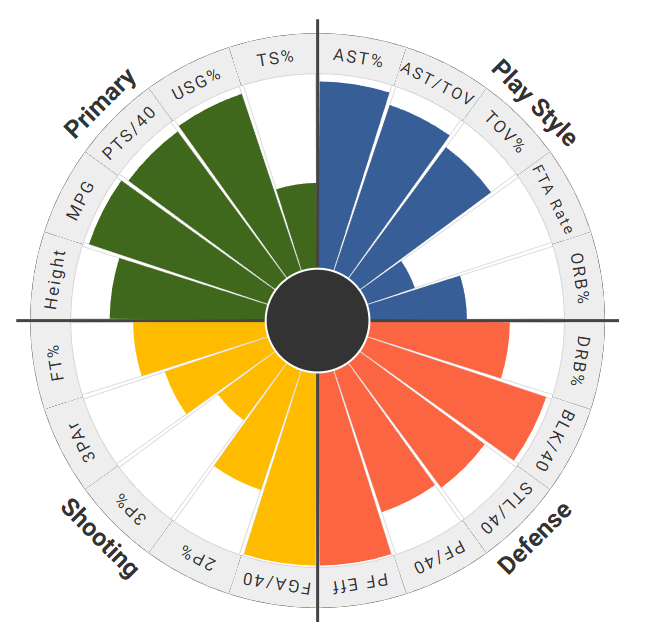
Jazzy Davidson
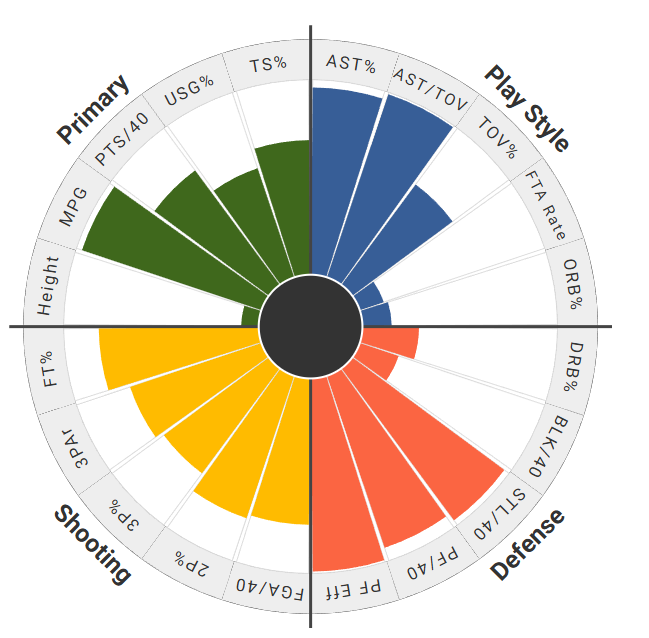
Aubrey Galvan
The radar wheels above, visually map these profiles. The farther outward a category extends, the stronger that metric grades relative to peers. Galvan’s wheel leans toward offensive efficiency, ball control, and shooting value. Davidson’s spreads across usage, defensive impact, steals, blocks, and overall two-way metrics. The wheels don’t declare a winner. They reveal stylistic identity. Again — neither wheel is better. They are different blueprints. And that’s important — because awards are not given based on style alone. They’re given based on production over a full season. The wheels show us how each player impacts the game.
Full Season Beyond Quad 1
This debate is not just about Quad 1 games. It’s about full-season production.
Across the entire season, Davidson leads USC in every major statistical category, grades in the 99th percentile in RAPM and WARP, and carries elite defensive metrics for her position.
Galvan posts elite offensive RAPM (99th percentile), strong efficiency, and slightly lower defensive influence while carrying lower usage.
These are measurable distinctions.
So, what does impact mean?
If impact means offensive efficiency, precision, and control, Galvan has a strong case.
If impact means two-way statistical influence, defensive impact, role load, and modeled win contribution, Davidson has a strong case.
Depending on what voter’s value, the answer changes.
And that’s the real debate.
I lean Jazzy Davidson — not because I’m USC biased, which I am, undoubtedly — but because when I evaluate impact, I prioritize two-way statistical influence. The numbers show she doesn’t just elevate USC offensively. She shifts possessions defensively just as much. That level of balance, especially at the freshman level, is rare.
Others may define impact differently.
Define impact — and you define your vote.
